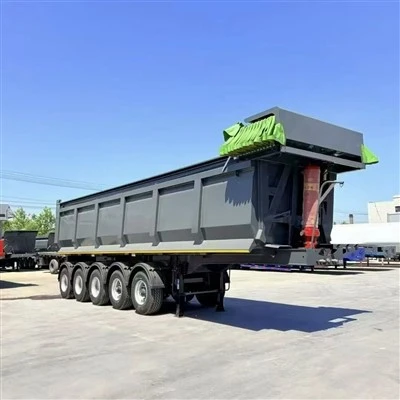
The semi-trailer adopts multiple lightweight and eco-friendly new materials for interior and exterior parts, including long fiber reinforced materials, low-density PP, low-VOC environmentally friendly materials, non-painting materials and halogen-free flame-retardant compliant materials.
Multiple methods are applied to cut the overall weight: thinner plates are used, and axles are made of high-strength and high-toughness steel; punching design on the body, reduced height of vertical plates and width of upper and lower flanges optimize curb weight; lightweight axle frames and disc-brake lightweight axles are adopted, while air suspensions replace steel leaf suspensions.
Meanwhile, auxiliary components such as bumpers, protective nets, spare tire carriers and tool boxes are lightweighted, realizing overall vehicle lightweighting for energy saving and efficiency improvement.
Replacing dual wheels with super single wheels can greatly reduce weight. Meanwhile, integrating electronic control chips, fuel tanks, ABS valves and other accessories simplifies the axle structure for further weight reduction. Axle weight reduction can be achieved by adopting high-strength steel, thinning brake parts and using lightweight components like bearings and wheel assemblies. Many vehicle owners worry that lightweight trailers with thin plates lack sufficient load capacity and safety, especially questioning the load-bearing performance of lightweight axles. However, weight reduction realized with new high-strength materials has little impact on load capacity and can fully meet daily freight transportation demands.

Conclusion
In the freight industry in the past, relevant management regulations were loose, and overloading was extremely common. Under such circumstances, the load-bearing capacity of axles was a top concern for vehicle owners. Environmental and performance standards required axles to not only meet the standard weight specifications, but also maintain stable performance under loads equal to 50% of the standard weight. Therefore, the concept of lightweight semi-trailer axles did not exist back then, and axles with superior load capacity were regarded as high-quality ones.