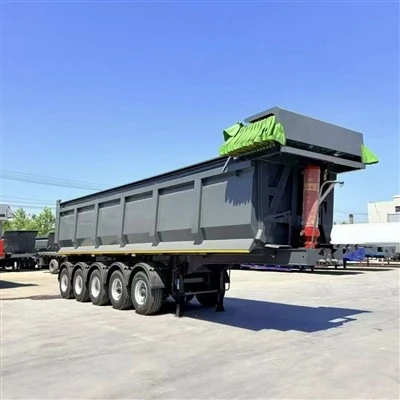
Dump Semi-Trailer

Dump semi-trailers are suitable for bulk materials like coal, ore, sand and building materials. They are divided into heavy off-road models for mining projects and light & medium road models. Adopting a rear-tipping structure, they improve loading and unloading efficiency. With manganese steel welded frame and precision manufacturing technology, the semi-trailer features high strength, large load capacity and stable durability for heavy transportation.
Low-bed semi-trailer
Flatbed semi-trailers have no side guardrails and are suitable for medium and long-distance freight transport. The frame adopts a perforated straight beam with movable gooseneck structure, with a height ranging from 400 mm to 550 mm. Its longitudinal beams are welded by automatic submerged arc welding, and the frame is shot-blasted for enhanced performance with firm welding. Equipped with dry spring suspension, it delivers excellent support and cushioning, featuring high rigidity and strength.
Standard versions carry heavy equipment including buses, construction machinery and agricultural machinery. Low-bed semi-trailers feature a concave beam frame composed of three parts: gooseneck, loading platform and wheel carrier, with machinery usually loaded and unloaded from the rear. The floor is made of high-strength steel, lightweight yet excellent in deformation resistance, shock resistance and load-bearing capacity. With a low center of gravity, it runs stably and safely.